
Decentralised vehicle architecture made sense when systems operated largely independently, with each electronic control unit (ECU) designed for a specific function.
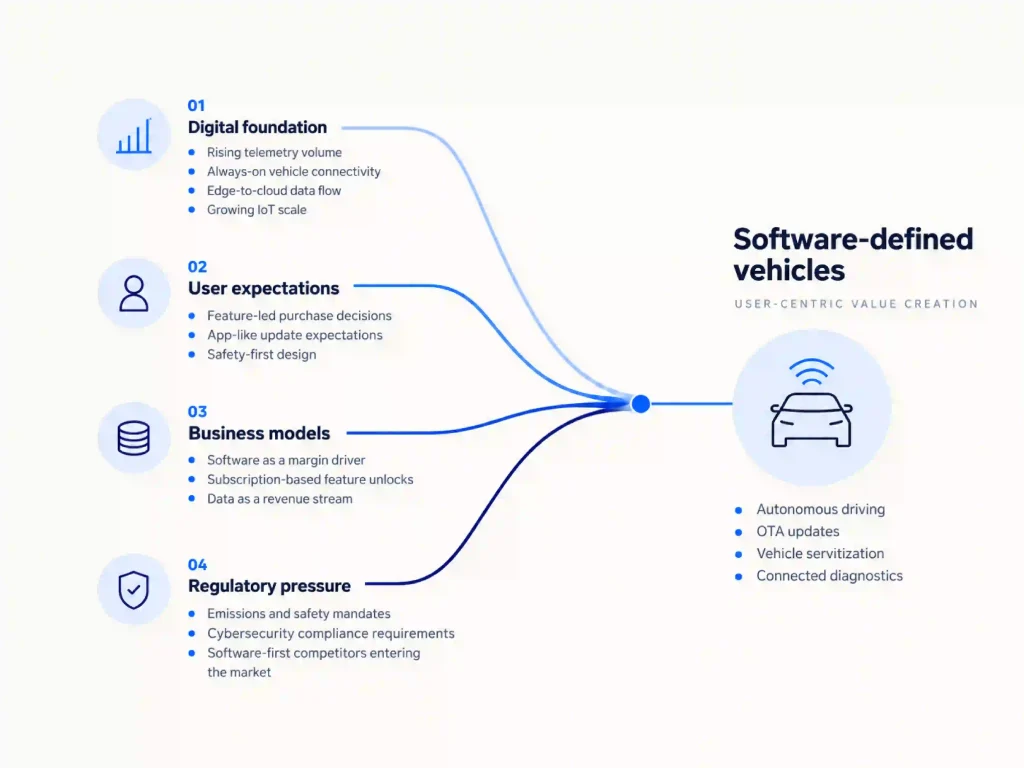
Modern vehicles work differently. According to McKinsey research, automotive software complexity has grown roughly four times over the past decade, while development productivity has grown only one to one and a half times. Global OEMs spent close to $38 billion on software in 2024, up from $26 billion in 2021, a roughly 14% annual increase.
This widening gap between software complexity and development capacity is placing greater pressure on validation timelines, system integration, software reuse, and the speed at which new capabilities can reach the road.
For OEMs, the question is no longer whether legacy architectures can be extended. It is how long they can be extended without limiting the vehicle’s software-defined potential.
That transition starts with separating hardware from software, so capability can be added and updated without touching the systems underneath every time.
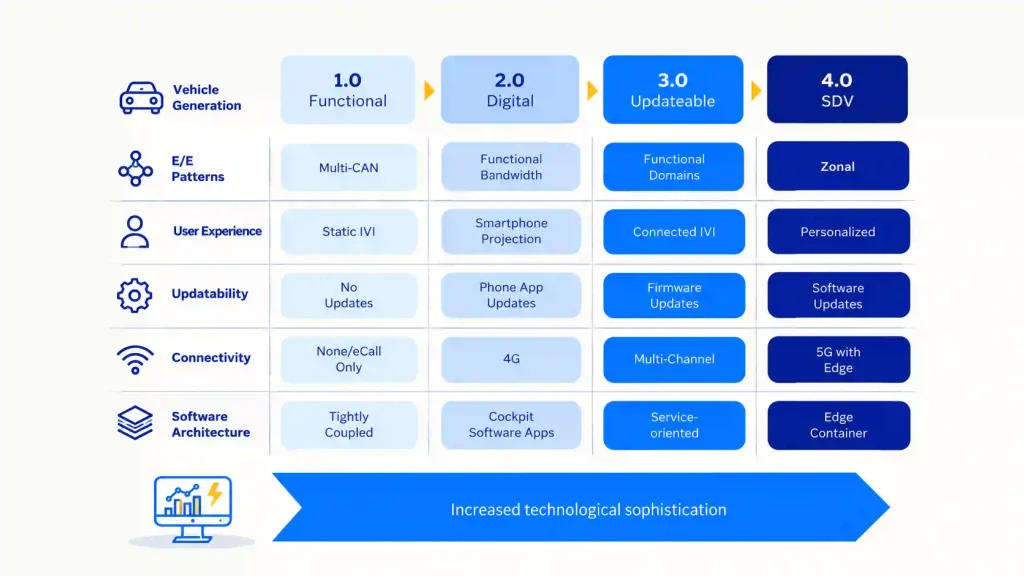
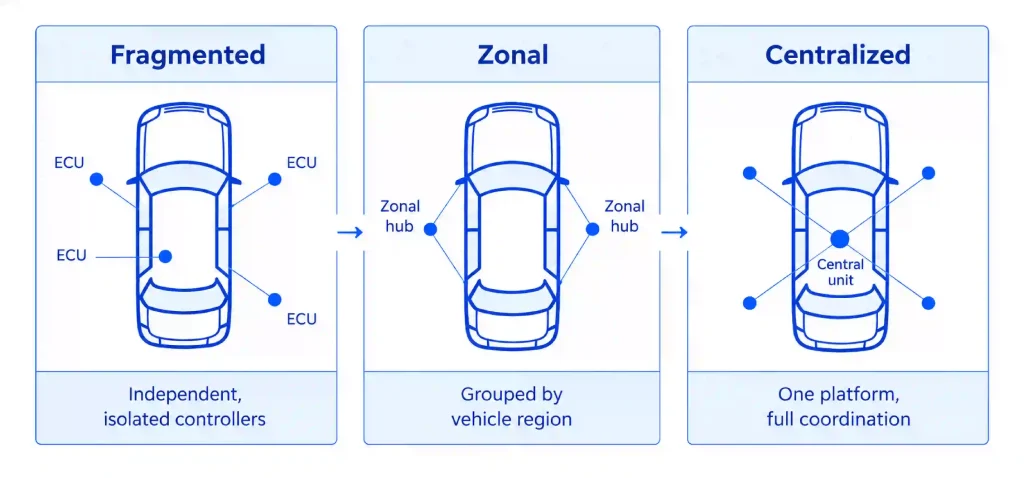
In a fragmented architecture (common in modern vehicles), individual ECUs manage specific functions independently. A domain-based architecture groups those controllers by function, such as powertrain, chassis, or infotainment, under a shared domain controller, cutting redundancy while keeping each function’s logic intact. A zonal architecture consolidates further by region of the vehicle, reducing wiring complexity and enabling coordination across functions regardless of domain. Centralised architecture completes the shift with a unified compute layer that unlocks over-the-air updates, AI-enabled features, and software-first business models.
Each stage delivers value on its own, so OEMs can evolve zone by zone rather than all at once. None of these stages move on their own, though. They depend on infrastructure to carry them from cloud to vehicle, and on a method to validate them along the way. That is where Quess’s role in this shift begins.
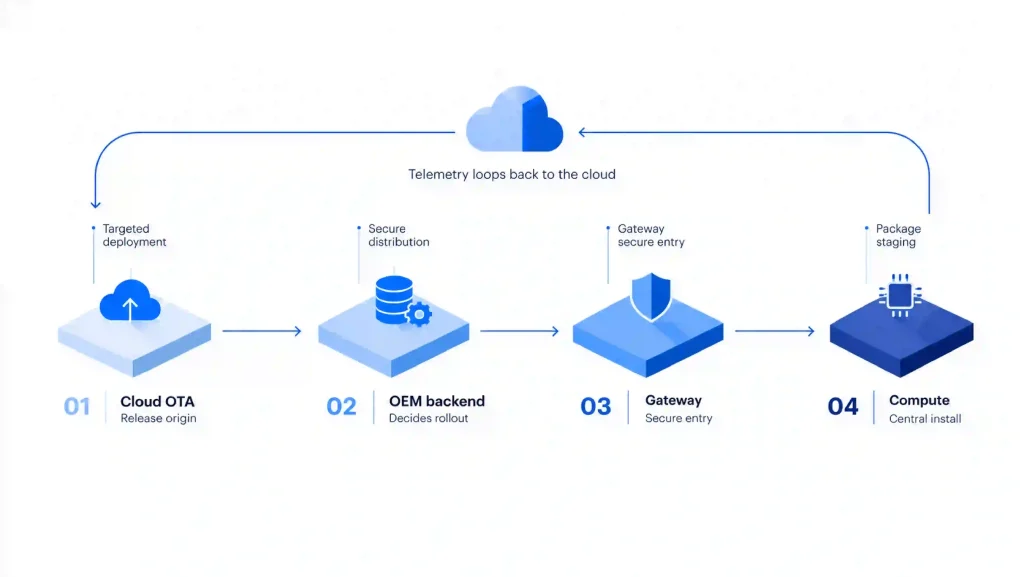
A software update typically begins on a cloud-based over-the-air platform, moves through the OEM backend for eligibility checks and scheduling, reaches the vehicle through a secure gateway, and is installed on the relevant zonal or central compute system. Encryption, authentication, version control, rollback mechanisms, and controlled deployment support every step. Once installed, the vehicle sends telemetry back to the cloud, closing the loop between development, deployment, and real-world performance.
Delivering that pipeline reliably, without disrupting what already runs, depends on changing how validation is done.
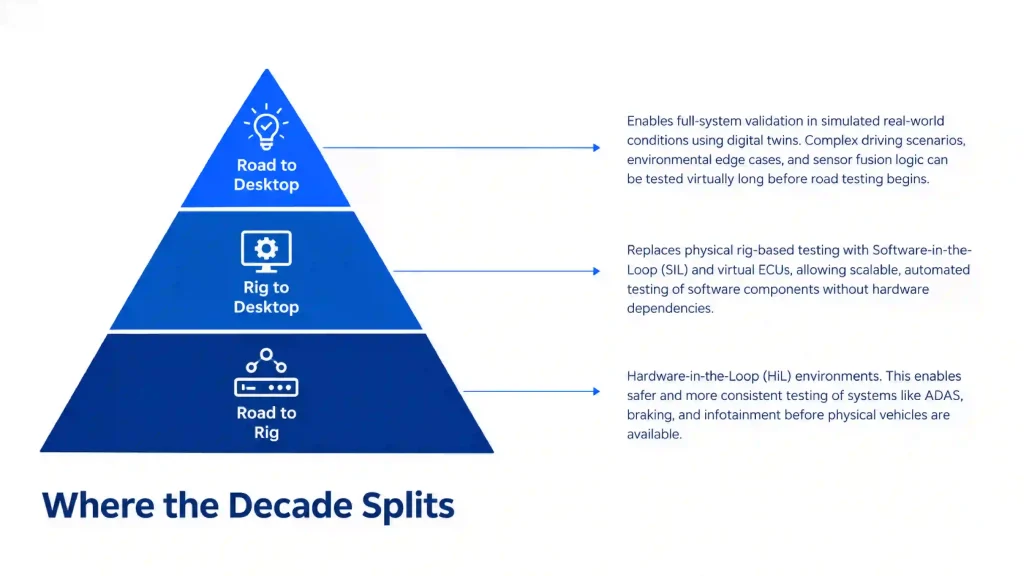
Road-to-rig testing moves selected on-road validation into hardware-in-the-loop (HIL) environments, allowing systems such as ADAS, braking, and powertrain controls to be tested under controlled and repeatable conditions.
Rig-to-desktop testing replaces physical rigs with software-in-the-loop (SIL) environments and virtual ECUs, enabling software to be validated at scale without depending on physical hardware for every test cycle.
Road-to-desktop testing uses vehicle models and digital twins to simulate broader system behaviour before physical testing begins. This allows software, integration, and performance issues to be identified earlier in the development process.
The same shift, from reactive to predictive, applies to the architecture itself.
Middleware layers decouple software from hardware, allowing code to move across compute platforms instead of being rebuilt for each one. Gateway ECUs bridge legacy protocols such as CAN and LIN with Ethernet-based zonal networks, helping connect old and new systems without requiring a full replacement. Virtual ECUs reproduce legacy functions in software, preserving existing functionality while more processing moves towards centralised compute. CI/CD-compatible pipelines bring legacy tooling into modern DevOps workflows, supporting a more unified delivery model across both environments. Data abstraction and edge analytics layers create greater visibility into diagnostics, vehicle performance, and predictive maintenance.
Testing catches earlier what might otherwise surface later in development. Architecture absorbs change that might previously have required a wider rebuild. Both move in the same direction: from reacting after the fact to identifying issues before they reach production or the road.