The banking industry has never been short on transformation. From branch banking to internet banking, mobile-first experiences, real-time payments and now intelligent, API-driven financial services, every wave of innovation has made banking more accessible, faster and more personalised. Yet every technological leap has also expanded the attack surface.
As financial institutions modernise legacy platforms, embrace cloud-native architectures and integrate fintech ecosystems, cybersecurity has moved from a control function sitting on the sidelines to a strategic capability that determines how quickly innovation can move safely.
At Quess IT, our Cybersecurity & Compliance Engineering practice operates at the heart of this shift rather than downstream of it. We work alongside our application engineering, cloud and data teams from the design phase, building identity, access and compliance controls into architectural decisions rather than layering them on once a platform is already in production.
Across our modernisation, cloud and digital banking engagements, security conversations now happen at the architecture stage, not immediately before go-live. This change in sequencing is arguably one of the most consequential shifts the industry has made in the past decade.
Innovation Has Outpaced Traditional Security Models
Digital banking is no longer confined to a bank’s own four walls. Customers interact through mobile apps, payment gateways, digital wallets, embedded finance platforms, wealth management portals and a growing network of fintech partners. Every API exposed to a partner, cloud workload deployed and third-party integration introduced adds another point of exposure.
The 2025 Verizon Data Breach Investigations Report found that third-party involvement in breaches had doubled over the previous year, signalling that enterprise security now extends well beyond organisational boundaries. The World Economic Forum’s Global Cybersecurity Outlook 2025 goes further, identifying supply chain vulnerabilities and ecosystem dependencies among the most significant risks organisations face today.
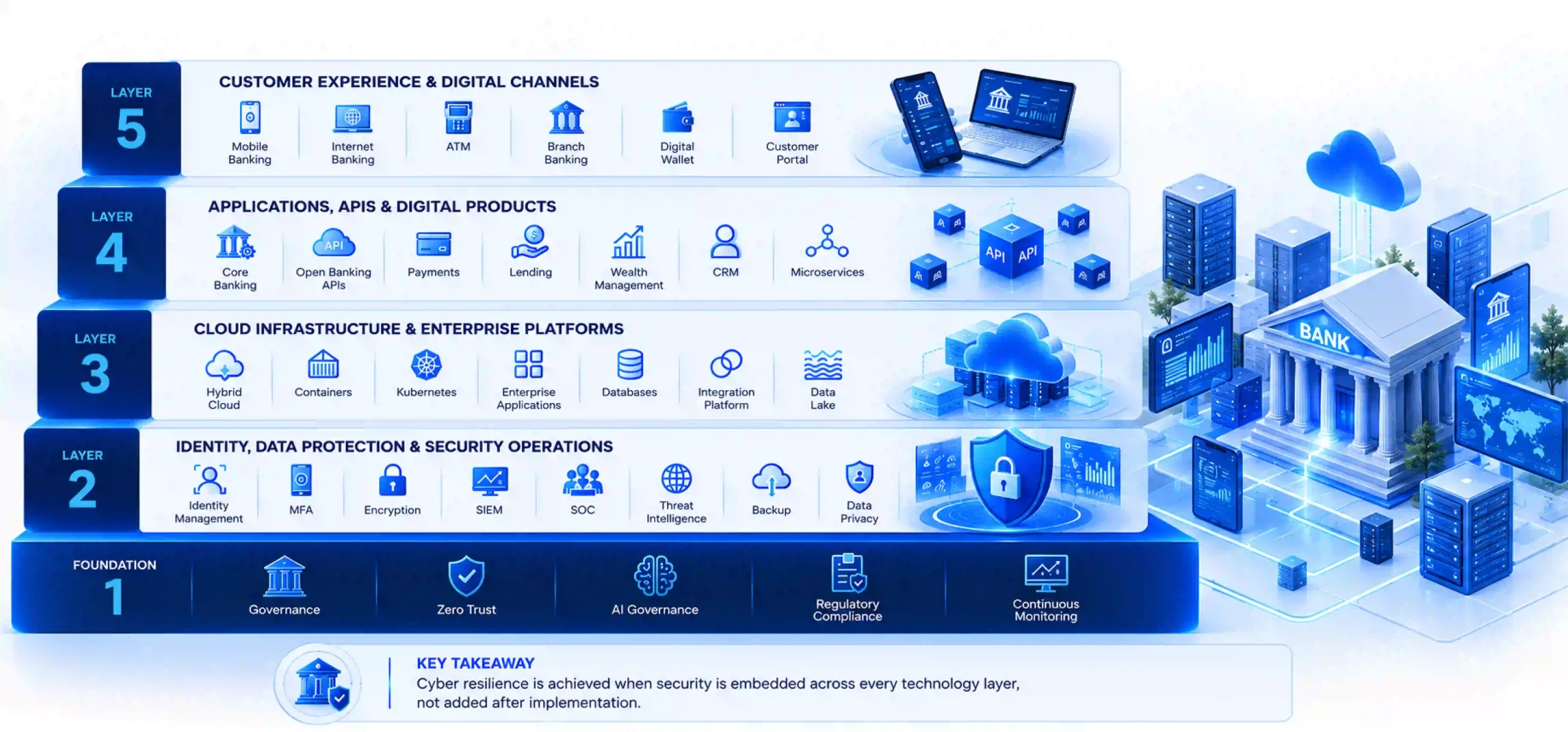
This changes what “owning security” means in practice. It cannot sit solely with infrastructure or security teams. It must be built into digital engineering, cloud architecture, software development, data governance and operational strategy from day one.
Our engineering teams treat identity and access management, secure API design and cloud security posture as part of the build itself, not as a separate audit conducted after development.
Security Is Becoming a Boardroom Conversation
Cybersecurity discussions are no longer limited to security teams. CEOs, boards, regulators, technology leaders, risk officers and business heads are now part of the conversation because the consequences of a cyber incident extend well beyond IT. These can include interrupted payment systems, exposed customer identities, disrupted digital channels, regulatory exposure and an almost immediate loss of customer confidence.
Regulators across India and the Asia-Pacific region are responding by prioritising operational resilience over periodic compliance checklists. The Reserve Bank of India’s Master Direction on IT Governance, Risk, Controls and Assurance Practices requires regulated entities to strengthen technology governance, cyber resilience, third-party risk management and board oversight.
The EU’s Digital Operational Resilience Act (DORA) establishes a comparable global benchmark for ICT risk management and resilience testing. ISO/IEC 27001:2022 continues to provide a foundation for building mature information security management systems, regardless of geography.
For organisations operating global capability centres in India, these frameworks are not abstract. They are actively shaping technology architecture, operating models and governance design.
Our compliance engineering work is built around this intersection, translating requirements such as the RBI’s IT governance framework, DORA and ISO/IEC 27001 into concrete architectural and control decisions rather than treating compliance as a documentation exercise separate from delivery.
AI Is Reshaping the Rules of Cybersecurity
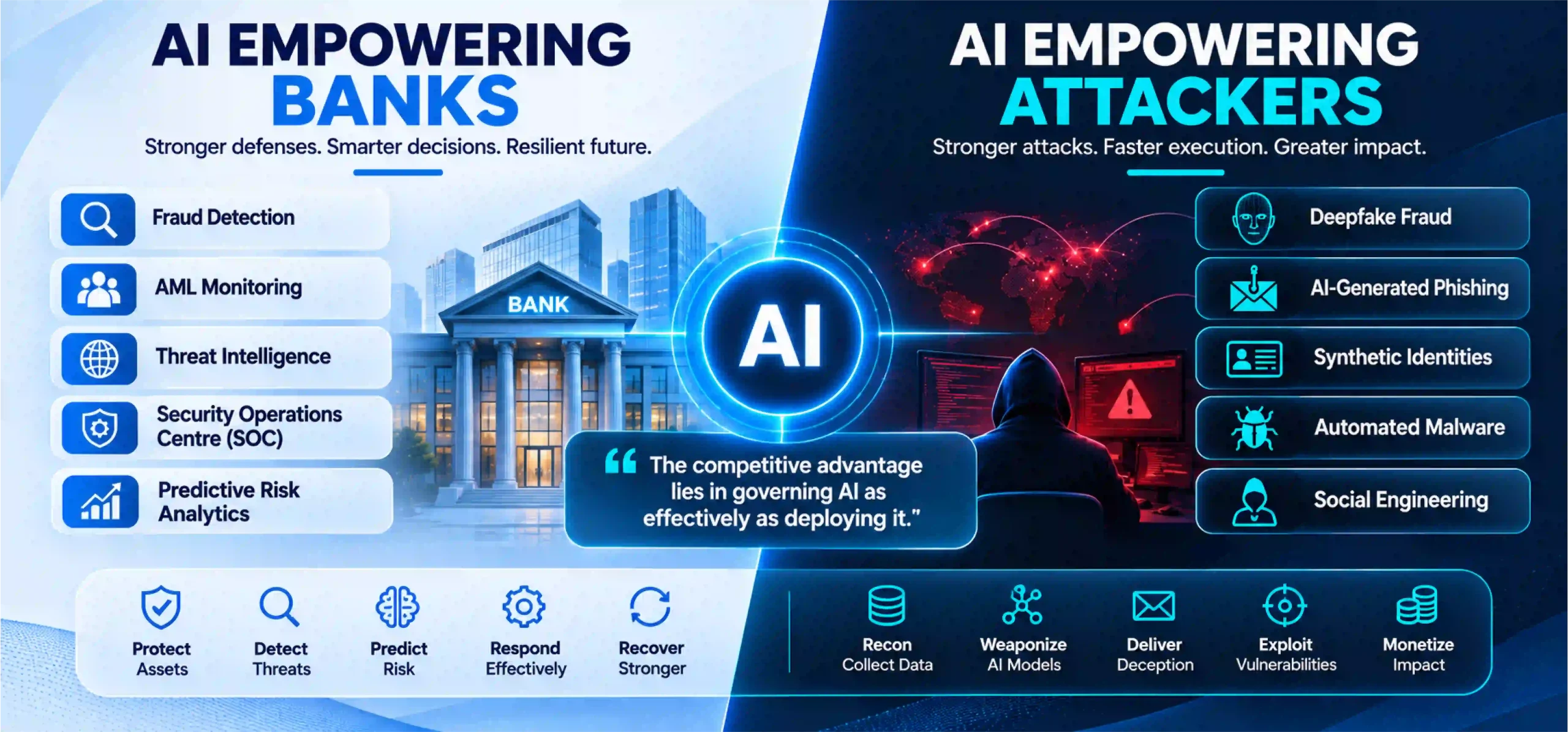
Attackers today are not relying on a single playbook. Ransomware and extortion campaigns continue to target operational uptime directly. Supply chain compromises exploit the same third-party dependencies banks rely on for speed. Insider and identity-based risks, including credential theft and privilege misuse, remain among the most difficult categories to detect.
Increasingly sophisticated AI-assisted techniques, including deepfake-enabled identity fraud and automated phishing generation, are also raising the baseline sophistication of social engineering attacks.
IBM’s 2025 Cost of a Data Breach Report found that organisations with mature, AI-assisted security operations identified and contained breaches significantly faster than those relying on manual detection alone. However, the underlying discipline that makes this possible is not AI itself. It is whether Zero Trust architecture, identity-first access controls, continuous monitoring and DevSecOps practices are already embedded in how systems are designed and deployed.
AI accelerates detection and response; it does not substitute for sound architecture.
This is where our Cybersecurity & Compliance Engineering practice does its core work: designing Zero Trust access models, embedding security checks into CI/CD pipelines and incorporating continuous monitoring into cloud and application platforms as they are deployed. This makes resilience a property of the system rather than a layer added afterwards.

Building Resilience Across an Open Financial Ecosystem
UPI, Account Aggregator, embedded finance, consent-driven data sharing and open banking are redefining customer experience across India’s financial ecosystem. In the process, they are creating unprecedented interconnection among banks, fintechs, payment providers, regulators and technology partners.
Security therefore stops being only an enterprise concern and becomes an ecosystem-wide responsibility. Banks must now secure APIs, digital identities, cloud workloads, third-party vendors, data pipelines and customer journeys simultaneously.
What separates institutions that recover quickly from a cyber incident is not necessarily budget size alone. It is whether technology, operations, governance, engineering and security teams have clear, shared ownership and repeatable processes. It also depends on whether Zero Trust and DevSecOps are operational practices rather than initiatives sitting on a roadmap.
This is the model our teams bring to every engagement: security engineered alongside cloud modernisation, application development and platform operations, and delivered by the teams building the platform rather than handed over to a separate audit function at the end.
What’s Next for Banking Leaders
Cloud-native platforms will continue to accelerate release cycles. Open finance will deepen ecosystem dependencies. Intelligent automation, including AI, will continue to raise the ceiling for both defence and attack.
None of this works if customers stop trusting the institution behind it. That trust is increasingly an engineering outcome, not simply a marketing one.
Our Cybersecurity & Compliance Engineering practice exists to make that outcome achievable at the pace at which banking now operates. This may involve designing Zero Trust access for a modernised core, building compliance controls into a cloud migration or embedding continuous monitoring into a platform that client teams are already building with us.
For organisations considering how much to build or buy, where to draw the line between compliance and architecture, or how to keep pace with a threat landscape evolving faster than most security roadmaps, these are the conversations we are having with banking and GCC clients today.
Speak to our team to learn more.
Research and Data References