

How MedTech is Adapting to Next-Gen EQMS and Tackling the Issue of Fragmented Quality Systems
The global medical device industry is on track to approach $800 billion by 2030, converging more closely than ever with digital health. That kind of growth changes what quality management is expected to deliver. It stops being a department that signs off at the end of a process and starts becoming a function the rest of the business depends on to move quickly.
Most MedTech quality leaders are running into the same wall on the way there. Quality systems built years ago for a slower, simpler business are now being asked to support real-time decisions, predictive risk and enterprise-wide traceability. Most were never designed for any of that.
Getting from where these systems are today to where the business needs them to be means answering three questions in order: Why is the current system struggling? What happens when organisations try to fix it the obvious way? And what actually works instead?
Quess helps MedTech organisations navigate all three, from the quality system itself to the data infrastructure that supports it.
MedTech Quality Management Is Now a Boardroom Priority
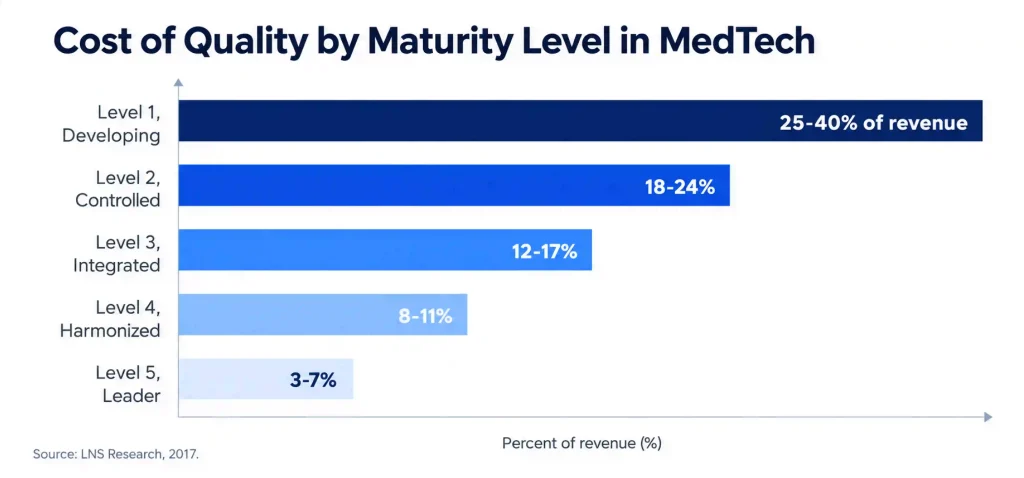
McKinsey research puts the average cost of quality across MedTech at 6.8–9.4% of sales, and the gap between organisations at different stages of quality maturity is not incremental. Companies with mature, integrated EQMS platforms report a cost of quality below 5%, while world-class organisations bring it below 3%.
At the industry level, McKinsey estimates that $6–11 billion a year could be recovered simply by adopting segment-leading quality practices. For an individual medium-to-large device manufacturer, a single non-routine quality failure can carry indirect costs of $1–3 billion.
That gap reflects what the underlying system is capable of. A quality function built to catch problems after they surface will always cost more to run than one built to prevent them. As the industry scales towards $800 billion, that cost difference scales with it.
Why Legacy Quality Systems Can't Keep Up
Three factors are keeping legacy quality systems from closing that gap.
The first is fragmentation. Years of acquisitions and business-unit growth have left many MedTech enterprises running multiple QMS platforms side by side, each customised and holding its own version of the truth, with no single view across the business.
The second is a talent and technology gap that has nothing to do with effort. Expertise in AI, machine learning and modern quality analytics remains scarce. Most legacy platforms were also never built to support the kind of automation these skills enable, even when the talent is available.
The third is regulatory pressure that has outgrown what these systems were designed to handle. ISO 13485, 21 CFR Part 820 and the EU MDR all expect end-to-end traceability from design and manufacturing through to the field. They require a level of detail that fragmented, siloed systems were never built to provide. At the same time, data privacy rules such as HIPAA have made many organisations cautious about the very cloud migration that could help.
None of these challenges can be solved by simply buying newer software. They are structural, which is precisely why the two responses most organisations reach for next do not hold up either.
Why a Full Overhaul or the Status Quo Both Fail
Faced with that structural gap, most organisations reach for one of two responses.
The first is a full platform overhaul: retire every legacy system at once and move the entire enterprise onto a single new QMS in one pass. It looks decisive. However, rollouts that skip process harmonisation before deployment encounter a predictable problem.
A generic migration plan cannot absorb years of business-unit-specific validation history all at once. Integration complexity, rather than the software itself, is what usually drives go-live delays and scope creep.
The second response is to hold steady: keep fragmented systems running in parallel and reconcile them manually whenever an audit demands it. It feels safer, but the risk compounds the longer it continues.
Every year of delay adds more manual workarounds, more knowledge that lives in someone’s head instead of the system, and a wider gap to close later. When a recall does occur, teams are still working from the same fragmented records that made the problem difficult to identify in the first place.
In an ETQ survey, 83% of organisations said an automated QMS had at least somewhat helped them recover from a product recall[4]. Standing still does not provide safety. It simply defers the cost.
Nathan Piland, CEO of Nunex, describes the tension beneath both choices well. As he puts it, “the commercialisation paradox in MedTech is unique”, since racing to market without appropriate quality systems or regulatory preparation often results in longer timelines and higher costs in the long run.
Neither a full rebuild nor standing still resolves that paradox.
What actually works sits between the two, but only under two conditions.
First, harmonise before deployment. Agree on what genuinely differs across business units and what does not before making any platform decision, rather than asking the software to settle that argument later.
Second, scope each stage narrowly so that no single phase has to absorb years of validation history at once. Otherwise, the organisation recreates the same problem that undermines a full overhaul, only spread across multiple stages rather than concentrated in one.
Sequenced this way, evolution avoids the go-live risk of a complete overhaul and the compounding cost of standing still. That sequencing, rather than simply “doing it in stages”, is the roadmap the rest of this piece explores.
The Shift From Paper Records to a Connected Quality System
That evolution follows a sequence.
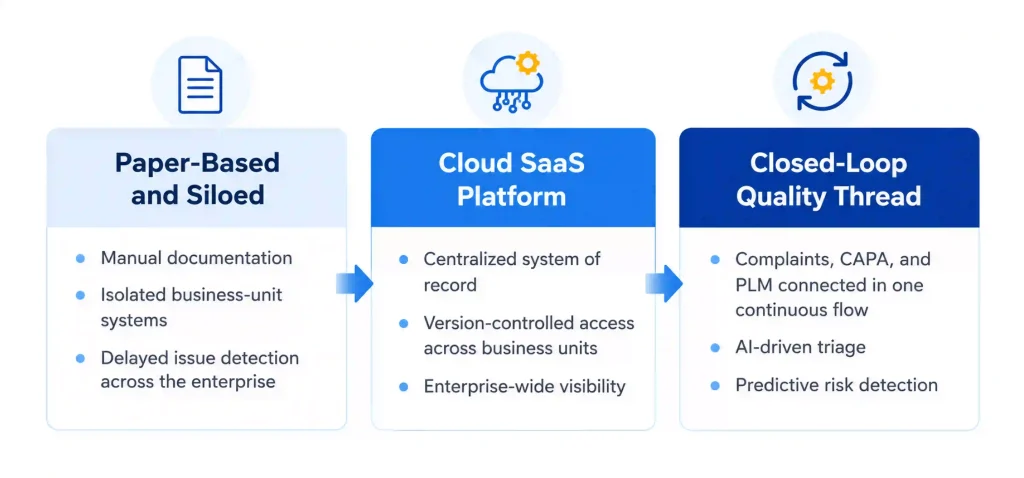
Many MedTech quality functions today still operate through paper-based or siloed digital records, where every document, CAPA and audit finding sits within its own system, disconnected from the next.
Cloud SaaS platforms represent the first stage of consolidation, giving the enterprise a single, version-controlled system of record that is accessible across business units instead of a separate system for each team.
The deeper shift comes next: a closed-loop quality thread in which complaints, non-conformance, CAPA and product lifecycle management are connected in one continuous flow. A single reported issue can then automatically trigger the next step without requiring a manual handover.
Each stage can stand on its own, allowing organisations to progress one system at a time rather than transforming everything at once. However, none of these stages works in isolation. They depend on the data flowing beneath them and on a clear roadmap for getting there.
The Data Layer Behind Real-Time Quality Management
A closed-loop quality thread is only as effective as the data reaching it.
IoT sensors on the manufacturing floor generate continuous telemetry on wear patterns, environmental conditions and performance in real time. That telemetry becomes useful once it integrates with ERP, LIMS, MES, PLM and CRM systems across the enterprise.
Increasingly, that data is also being brought into a cloud data lake designed for analysis at scale — the same architectural pattern on which many modern EQMS platforms have already standardised.
Once that data layer exists, AI and machine learning stop being add-ons and start performing meaningful quality-management tasks.
Complaint data can be automatically classified and routed without manual triage. Non-conformance events can be triggered automatically instead of waiting for someone to identify a pattern. Predictive models can forecast wear and tear on products already in the field, identifying problems before they lead to recalls.
How Quess Helps MedTech Navigate This Shift
Moving from a fragmented system to a connected one requires a phased transformation. Quess builds the two conditions outlined above directly into that phasing rather than treating them as an afterthought.
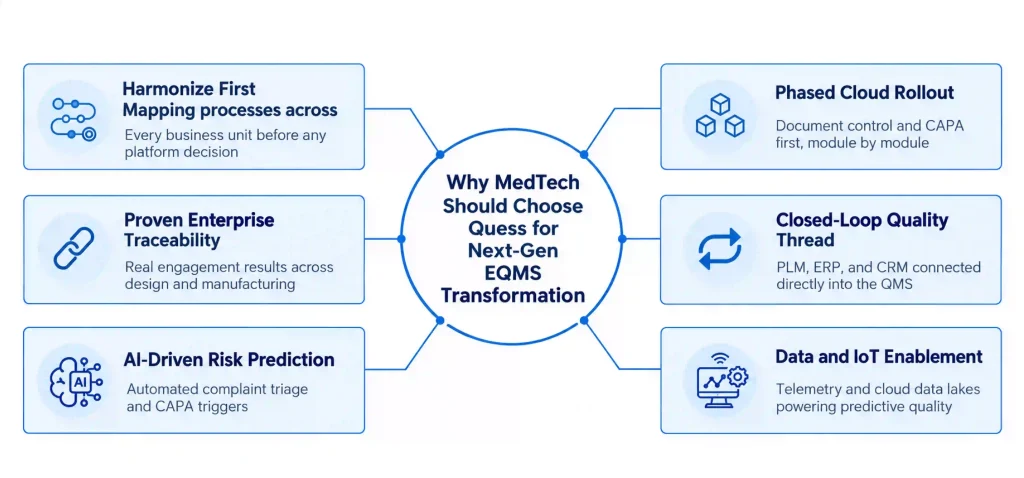
Harmonisation comes first: mapping quality processes across every business function to identify what genuinely overlaps and what is legitimately different, and agreeing on a focused set of KPIs before making any platform decision.
Skipping this step turns the rollout that follows into a slower version of the same all-at-once overhaul that fails elsewhere.
Only once that foundation is in place does Cloud SaaS roll out, module by module, beginning with document control and CAPA. This ensures that no single phase has to absorb more validation history than it can manage.
The closed-loop quality thread comes next, connecting PLM, ERP and CRM systems directly to the core QMS and bringing Statistical Process Control and analytics into decision-making in real time rather than at the next audit cycle.
The final stage introduces mobile access, IoT connectivity, AI and machine learning for predictive risk alerts, turning the platform into a data-driven engine connecting engineering, manufacturing and service.
Two recent engagements demonstrate how this works in practice.
In one, Quess built a single, standard quality-management process spanning design and manufacturing across an entire enterprise, delivering complete traceability through one global process for the first time.
In another, the team built the closed-loop quality thread itself. AI and machine learning were used to determine whether a reported issue was a genuine complaint and automatically assign the correct complaint code. As a result, non-conformance events now trigger automatically for genuine complaints, with manual intervention removed and traceability fully maintained.
EQMS as a Growth Enabler
For years, the question MedTech quality teams asked was simple: What problem are we solving?
That question built systems designed to catch issues after they occurred — the same systems that leave the industry-wide cost of quality at 6.8–9.4% of sales
The better question is: What does a connected system make possible?
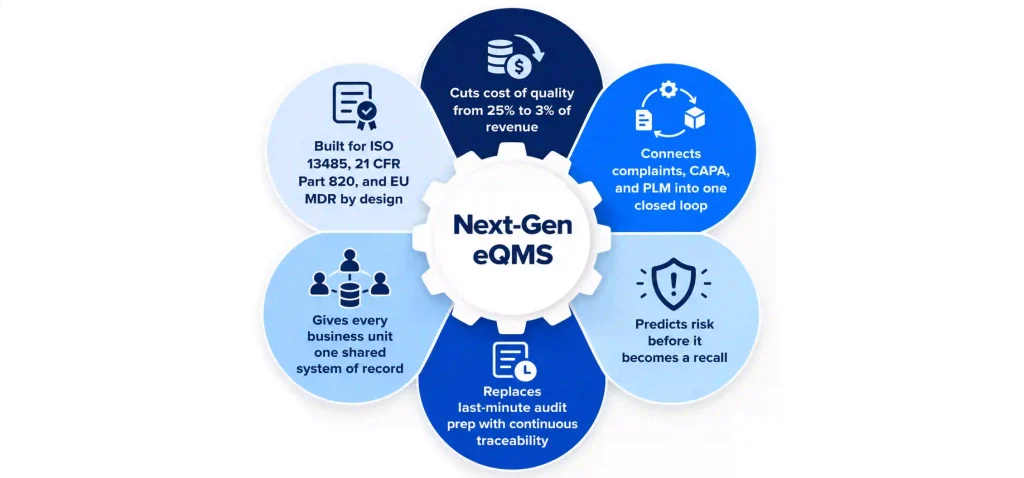
A closed-loop quality thread does more than close audit findings faster. It can bring the cost of quality closer to the sub-3% levels achieved by world-class organisations, identify risk before it becomes a recall, and shorten the time required to bring products to market.
That turns EQMS from a line item the business tolerates into an asset that enables growth.
Quess builds that shift into the quality systems already operating within your organisation, one process and one validated step at a time. The starting point is wherever your current system stands.
Research and Data References:
- KPMG, “Medical Devices 2030”
Global annual medical device sales are forecast to grow by more than 5% a year, reaching nearly $800 billion by 2030.
https://kpmg.com/us/en/articles/2023/medical-devices-2030.html - McKinsey & Company, “Capturing the Value of Good Quality in Medical Devices”
Industry cost of quality at 6.8–9.4% of sales; $6–11 billion a year recoverable industry-wide through segment-leading quality practices; and indirect costs of non-routine quality failures reaching $1–3 billion for a medium-to-large device manufacturer.
https://www.mckinsey.com/industries/life-sciences/our-insights/capturing-the-value-of-good-quality-in-medical-devices - MedDeviceGuide, “Cost of Quality in Medical Devices”
Presents the mature-EQMS cost of quality as below 5% and the world-class level as below 3%, based on the McKinsey figures.
https://meddeviceguide.com/blog/cost-of-quality-medical-devices-guide - ETQ, “4 Stats That Show How Quality Management Impacts Product Recalls”
83% of organisations said an automated QMS had at least somewhat helped them recover from a product recall.
https://www.etq.com/blog/4-stats-that-show-how-quality-management-impacts-product-recalls-2/ - Nunex, “What MedTech CEOs Need to Know in a Pivotal 2025”
Source for Nathan Piland’s observation on the “commercialisation paradox” in MedTech.
https://www.nunex.co/news-posts/what-medtech-ceos-need-to-know-in-a-pivotal-2025

Share on